
Blog Reason for Compounding and ICD-10 on Every Compounded Prescription: Enter It Once, Not Every Month
November 26, 2026Reason for Compounding and ICD-10 on Every Compounded Prescription: Enter It Once, Not Every Month
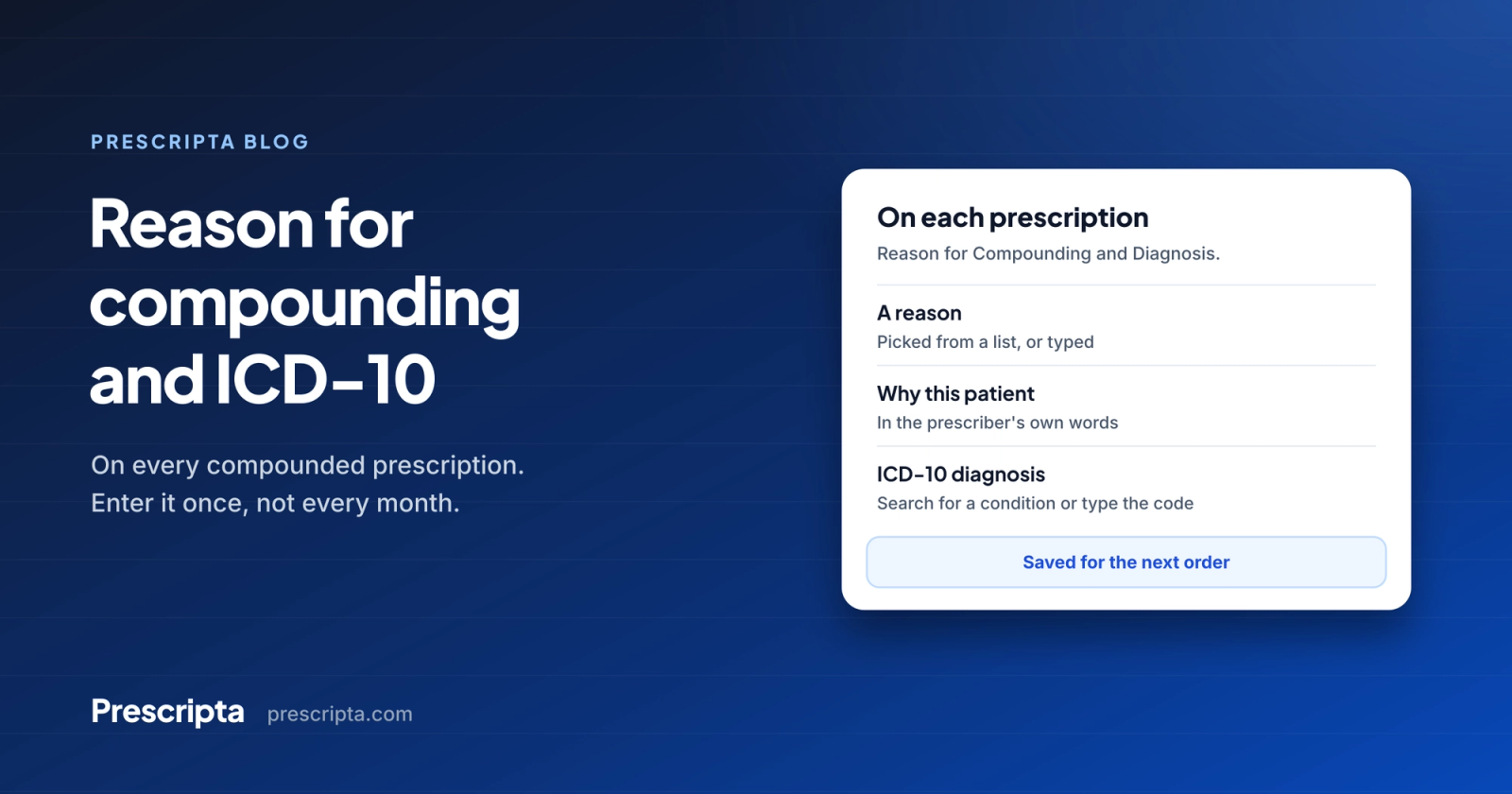
More compounding pharmacies now ask the prescriber two things on each order. Why does this patient need a compounded medication? And what is the diagnosis? An order without them can come back refused.
For a clinic with a few hundred monthly refills, typing that on every order is hours of work. It is also where mistakes happen.
Where It Goes in Clinic Manager
On the Clinic Manager order form, each prescription has a section called Reason for Compounding and Diagnosis. It holds three things:
- a reason picked from a list, or typed,
- why this patient needs it compounded, in the prescriber's own words,
- an ICD-10 diagnosis. You can search for a condition or type the code.
All of it is optional. The prescriber decides what to write. The software does not decide medical need for anyone.
Type It Once
What you enter is saved with that patient's prescription for that drug. On the patient's next order it is already filled in. Change it on the form to update it. Clear it to stop using it.
A list also offers what your clinic has entered before for other patients, with the same drug first. Pick one and adjust it for this patient. That list belongs to your clinic alone.
What the Pharmacy Gets
Each pharmacy receives the reason and the diagnosis in the place its own system has for them. On an eFaxed prescription they are printed on the page.
Start a free 7-day demo trial of Prescripta Clinic Manager and see it with a sample clinic. It is $99 a month per clinic with unlimited users.
Frequently asked questions
Do I have to enter a reason for compounding on every order?
No. It is saved with the patient's prescription for that drug and fills in on the next order.
Is the reason for compounding required?
No. It is optional in Clinic Manager. Your pharmacy may ask for it.
Can I search for an ICD-10 code?
Yes. Search for a condition or type the code yourself.
More from the Prescripta blog
Changing a follow-up schedule should not make every TRT or GLP-1 patient overdue. See how Clinic Manager re-applies new steps and keeps the last visit.
Inactive patients clutter your work lists and hide the ones who need you. See how Clinic Manager moves them aside and brings them back on a new order.
A husband and wife on monthly medication should not pay shipping twice. See how Clinic Manager pairs orders to one address into one shipment.
Send refill and follow-up reminder e-mails to GLP-1, TRT and hormone patients without putting health details in an inbox. Here is how Clinic Manager does it.
NexaMed is the healthcare marketing agency behind Prescripta. See how its marketing for HRT, TRT, peptide and GLP-1 clinics pairs with Clinic Manager.
Keragon lets you build your own HIPAA workflows. Clinic Manager comes already built for HRT, TRT, peptide and GLP-1 clinics at $99 a month. Compare both.
Charm EHR's Provider Plan is $200 per provider a month, and nurse practitioners count. Here is how the add-ons and overages add up, from Charm's own pricing page.
Many clinics hire a virtual assistant to chase membership renewals, refills and failed payments. Here is the HIPAA risk in sharing a login, and what software does instead.
Most med spa and aesthetic platforms have memberships and packages built in. They are built for services and credits. A GLP-1, hormone, or TRT membership is a medication on a schedule, and that needs a different kind of list.
Failed autopay, the paid month that does not match the medication month, downgrades that force refunds, liability nobody can see, and the handoff between billing and the pharmacy order. What each one costs and how to run it so it stops happening.
A working system for monthly medication memberships, from the spreadsheet that gets a new clinic through its first fifty members to the point where it breaks, and what replaces it.
Clinics shop for an OptiMantra alternative for three reasons: cost that climbs with add-ons and seats, a learning curve, and no way to track monthly medication memberships. Two of those have a replacement answer. The third has a cheaper one.
OptiMantra includes membership and package management in its base price. Here is what that covers, what its own guidance leaves to the clinic, what reviewers say about payments and reporting, and how clinics fill the gap without leaving OptiMantra.
Most clinics re-type every monthly GLP-1, hormone, and TRT refill into the pharmacy's portal. Prescripta Clinic Manager sends the order from the member's own row, pre-filled from the last one, and brings shipped and tracking back to the same screen.
Prescripta is an all-in-one EHR for specialty and wellness practices: booking, portal, charting with Quill AI, eRx, labs, eFax, payments, and a compounding pharmacy partner, on one bill.
A practical checklist for evaluating specialty EHRs: charting, prescriptions, labs, AI, scheduling, and the safeguards that make records hold up.
AI in an EMR should mean notes drafted during the visit, safer prescriptions, and a team that misses nothing. Here is what AI actually does inside a modern specialty EHR.
Zenoti runs the business side of spas and med spas well. When clinical care enters the picture, practices need a real EHR. Here is how to tell which side of that line you are on.
OptiMantra and Prescripta both target integrative and wellness clinics. Here is how they differ on charting, AI, prescribing safety, and day-to-day workflow.
How Prescripta and Cerbo compare for specialty and functional medicine practices, and the questions that actually decide which EHR fits your clinic.