
Blog Hiring a Virtual Assistant to Manage Clinic Memberships? Read This Before You Share the EHR Login
November 15, 2026Hiring a Virtual Assistant to Manage Clinic Memberships? Read This Before You Share the EHR Login
Many weight-loss, hormone and wellness clinics hire a virtual assistant to keep memberships running: who is due for a reorder, whose card failed, who needs a follow-up call. It looks cheap. One VA company's 2026 pricing guide puts most practices at $8 to $13 an hour for a managed medical assistant. The risk is in how the assistant gets into your systems.
The shared login problem
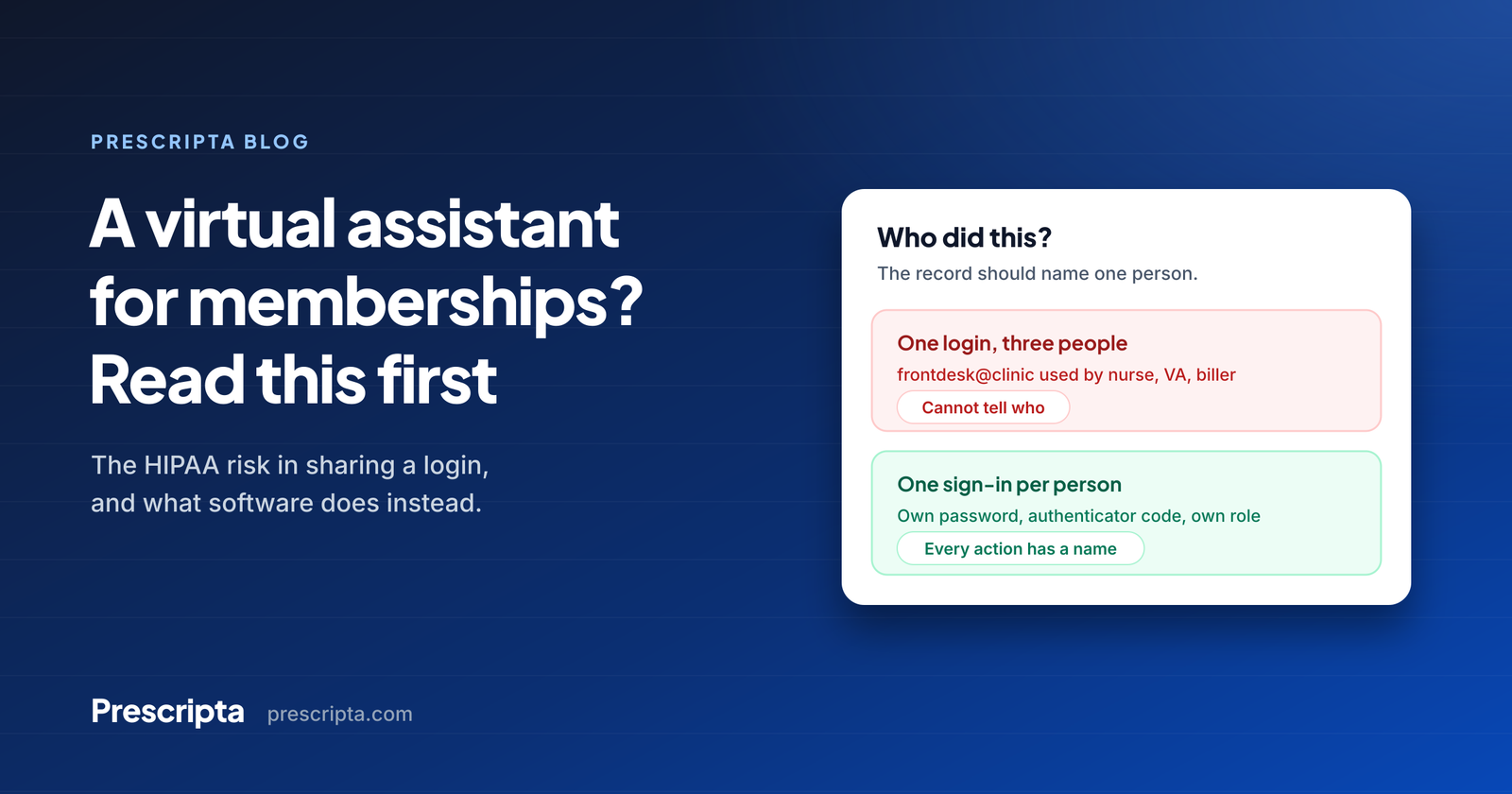
The fastest way to get a new assistant working is to hand over a login someone already uses. HIPAA does not allow that. HHS's own security guidance lists Unique User Identification as a required part of the Security Rule. Each person who touches patient records needs their own sign-in, so every action traces back to one person.
With a shared login, your audit trail shows your nurse's name on work the assistant did. If something goes wrong, you cannot show who did it.
The agreement most clinics skip
A virtual assistant company that works in your patient records is a business associate. A business associate is someone outside your own workforce who handles patient information to do a job for you, and a vendor with routine access to that information has to sign a Business Associate Agreement.
Ask who signs it. One VA provider's own guidance says the agreement belongs between your clinic and the outsourcing company, not the individual assistant. A freelancer hired through a marketplace often has no company behind them to sign.
More access than the job needs
Chasing renewals needs a name, a membership, a date and a payment status. A full EHR login shows charts, notes and lab results. Even VA companies advise against giving an assistant full access when the task does not need it.
What the work actually is
Look at what a membership assistant does all day:
- Checks who runs out of medication soon and has no order placed.
- Finds memberships whose autopay failed.
- Lists patients due for a nurse follow-up.
- Tracks which pharmacy orders shipped.
- Matches refill requests to patients.
Every item is a list built from data your systems already hold. A person builds those lists by hand, every day, by reading through your EHR.
What software does instead
Prescripta Clinic Manager builds those lists for you. It connects to OptiMantra or Zenoti and shows reorders due, failed payments, follow-ups due and pharmacy orders in one place, with a morning brief of what needs attention first.
It is $99 a month per clinic with unlimited users. Each staff member has their own sign-in with an authenticator code, roles limit what each person can see, and Prescripta signs a Business Associate Agreement.
You may still want an assistant to make the calls. The difference is that they work from a short list under their own sign-in, with only the access the job needs.
Questions to ask before you hire
- Will the assistant have their own login to every system?
- Will the company, not just the individual, sign a Business Associate Agreement?
- What is the least access that gets the job done?
- Can I see a record of everything they opened?
This article is general information, not legal advice. Ask your attorney or compliance advisor about your own situation.
More from the Prescripta blog
Charm EHR's Provider Plan is $200 per provider a month, and nurse practitioners count. Here is how the add-ons and overages add up, from Charm's own pricing page.
Most med spa and aesthetic platforms have memberships and packages built in. They are built for services and credits. A GLP-1, hormone, or TRT membership is a medication on a schedule, and that needs a different kind of list.
Failed autopay, the paid month that does not match the medication month, downgrades that force refunds, liability nobody can see, and the handoff between billing and the pharmacy order. What each one costs and how to run it so it stops happening.
A working system for monthly medication memberships, from the spreadsheet that gets a new clinic through its first fifty members to the point where it breaks, and what replaces it.
Clinics shop for an OptiMantra alternative for three reasons: cost that climbs with add-ons and seats, a learning curve, and no way to track monthly medication memberships. Two of those have a replacement answer. The third has a cheaper one.
OptiMantra includes membership and package management in its base price. Here is what that covers, what its own guidance leaves to the clinic, what reviewers say about payments and reporting, and how clinics fill the gap without leaving OptiMantra.
Most clinics re-type every monthly GLP-1, hormone, and TRT refill into the pharmacy's portal. Prescripta Clinic Manager sends the order from the member's own row, pre-filled from the last one, and brings shipped and tracking back to the same screen.
Prescripta is an all-in-one EHR for specialty and wellness practices: booking, portal, charting with Quill AI, eRx, labs, eFax, payments, and a compounding pharmacy partner, on one bill.
A practical checklist for evaluating specialty EHRs: charting, prescriptions, labs, AI, scheduling, and the safeguards that make records hold up.
AI in an EMR should mean notes drafted during the visit, safer prescriptions, and a team that misses nothing. Here is what AI actually does inside a modern specialty EHR.
Zenoti runs the business side of spas and med spas well. When clinical care enters the picture, practices need a real EHR. Here is how to tell which side of that line you are on.
OptiMantra and Prescripta both target integrative and wellness clinics. Here is how they differ on charting, AI, prescribing safety, and day-to-day workflow.
How Prescripta and Cerbo compare for specialty and functional medicine practices, and the questions that actually decide which EHR fits your clinic.