
Blog What to Look For in an All-in-One EHR for Specialty and Wellness Practices
August 20, 2026 · Updated November 16, 2026What to Look For in an All-in-One EHR for Specialty and Wellness Practices
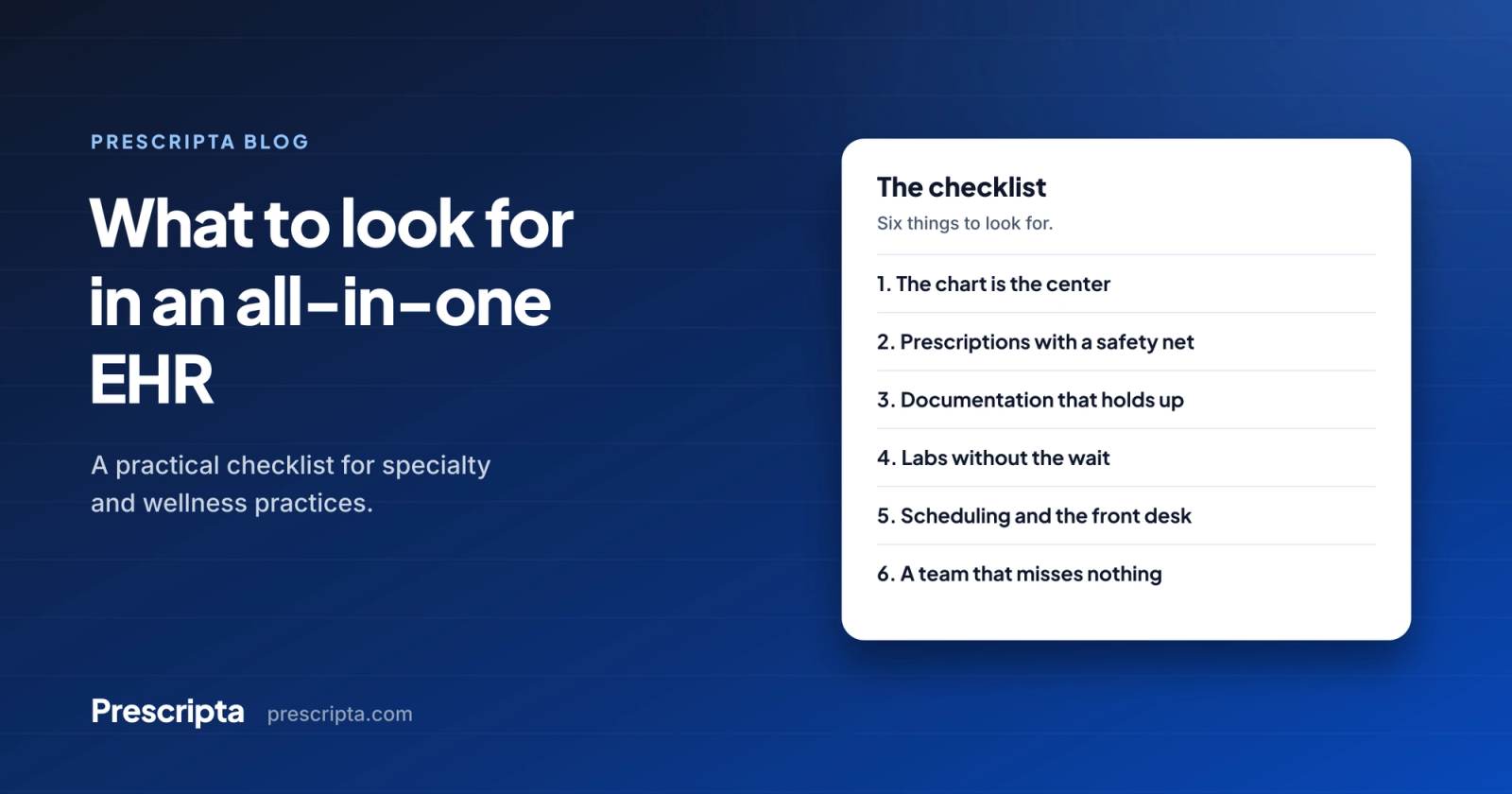
An all-in-one EHR for a specialty or wellness practice needs to cover six things well: patient charts, prescriptions with safety checks, clinical documentation that holds up, labs, scheduling, and team workflow. Miss any one and the practice ends up gluing tools together with spreadsheets and memory. This checklist walks through each, with what good looks like, so you can evaluate any vendor, including us.
1. The patient chart is the center
Everything should connect to one chart: patient info, contacts, history, allergies, conditions, tags, and past visits in one place. When you open a visit, the full picture should already be there. In Prescripta, every chart, medication, allergy, lab, and past note lives in the platform, and built-in ICD-10 code lookup learns the codes your practice uses most.
2. Prescriptions with a real safety net
- Every script checked in real time against allergies, drug classes, and single ingredients before it goes out.
- Each prescription saved as its own legal record.
- An AI prescribing review that reads the script with the whole patient in mind and flags what to check. Advisory only, never autonomous, every check logged.
Cash-based practice software often treats prescribing as an afterthought. For hormone therapy, weight management, and functional medicine, it is the core of the clinical risk, and the EHR should treat it that way.
3. Documentation that holds up
Notes need to be fast to write and impossible to quietly rewrite. Look for both:
- Speed: AI charting that drafts a signature-ready note during the visit. In Prescripta this is Quill, and the clinician stays the author.
- Defensibility: signing locks the note with a time-stamped snapshot. Amendments create new tracked versions and the original is never erased.
4. Labs without the wait
Lab orders should go out from the chart, tied to the visit that created them, with results returning to one place and abnormal or urgent values flagged instead of hiding in a PDF. Interoperability standards such as HL7 are what make clean lab and records exchange possible, so ask any vendor how their platform connects to the outside clinical world.
5. Scheduling and the front of house
A full practice calendar belongs inside the EHR: book visits, see day, week, and month views, with time zones handled correctly. Online booking and a patient-facing experience should feed the same system the clinical side runs on, not a separate database that someone reconciles by hand.
6. A team that misses nothing
Tasks you can make, assign, and track. Notifications that surface refills due, labs to review, and follow-ups to the whole team, and escalate until they are handled. The software should carry the remembering.
The non-negotiables underneath
- HIPAA-aligned, isolated data. Each practice's data stays its own and is never used to train AI models.
- One platform, one bill. The point of all-in-one is ending the subscription patchwork.
- Honest AI boundaries. AI drafts and advises. Clinicians author and decide.
- A vendor building for your kind of practice. Specialty and wellness clinics have different economics than hospital systems. The roadmap should show it.
The bottom line
Print this list and score any EHR against it. Prescripta was built to answer every item as an all-in-one EHR for specialty and wellness practices: specialty EMR charting, real-time prescription safety, AI charting with Quill, labs from the chart, scheduling, and team workflow in one platform.
Frequently asked questions
What does all-in-one actually mean in an EHR?
It means charts, prescriptions, notes, labs, scheduling, and tasks are native to one platform with one login and one bill, not a bundle of separate products.
Is AI charting a separate product in Prescripta?
No. Quill is built into the platform. It drafts a signature-ready note during the visit and the clinician signs the final record.
Does Prescripta support cash-based practices?
Yes. Prescripta is built for the way specialty and wellness clinics operate, including cash-based and membership models.
What should an all-in-one EHR include?
Six things: patient charts, prescriptions with safety checks, notes that hold up, labs, scheduling, and team workflow. If one is missing, the practice ends up gluing tools together.
Why does HL7 matter when choosing an EHR?
HL7 is a standard that lets systems share labs and records cleanly. Ask any vendor how their platform connects to labs and other clinical systems.
Related in Prescripta: Quill · Platform · All-in-one EHR for cash-pay clinics
More from the Prescripta blog
Charm EHR's Provider Plan is $200 per provider a month, and nurse practitioners count. Here is how the add-ons and overages add up, from Charm's own pricing page.
Many clinics hire a virtual assistant to chase membership renewals, refills and failed payments. Here is the HIPAA risk in sharing a login, and what software does instead.
Most med spa and aesthetic platforms have memberships and packages built in. They are built for services and credits. A GLP-1, hormone, or TRT membership is a medication on a schedule, and that needs a different kind of list.
Failed autopay, the paid month that does not match the medication month, downgrades that force refunds, liability nobody can see, and the handoff between billing and the pharmacy order. What each one costs and how to run it so it stops happening.
A working system for monthly medication memberships, from the spreadsheet that gets a new clinic through its first fifty members to the point where it breaks, and what replaces it.
Clinics shop for an OptiMantra alternative for three reasons: cost that climbs with add-ons and seats, a learning curve, and no way to track monthly medication memberships. Two of those have a replacement answer. The third has a cheaper one.
OptiMantra includes membership and package management in its base price. Here is what that covers, what its own guidance leaves to the clinic, what reviewers say about payments and reporting, and how clinics fill the gap without leaving OptiMantra.
Most clinics re-type every monthly GLP-1, hormone, and TRT refill into the pharmacy's portal. Prescripta Clinic Manager sends the order from the member's own row, pre-filled from the last one, and brings shipped and tracking back to the same screen.
Prescripta is an all-in-one EHR for specialty and wellness practices: booking, portal, charting with Quill AI, eRx, labs, eFax, payments, and a compounding pharmacy partner, on one bill.
AI in an EMR should mean notes drafted during the visit, safer prescriptions, and a team that misses nothing. Here is what AI actually does inside a modern specialty EHR.
Zenoti runs the business side of spas and med spas well. When clinical care enters the picture, practices need a real EHR. Here is how to tell which side of that line you are on.
OptiMantra and Prescripta both target integrative and wellness clinics. Here is how they differ on charting, AI, prescribing safety, and day-to-day workflow.
How Prescripta and Cerbo compare for specialty and functional medicine practices, and the questions that actually decide which EHR fits your clinic.