
Blog Changed Your Follow-Up Schedule? How to Move Every Existing Patient Without Making Them All Overdue
November 26, 2026Changed Your Follow-Up Schedule? How to Move Every Existing Patient Without Making Them All Overdue
Clinics change their protocols. Labs move from every 90 days to every 120. A new check-in is added at week six. The hard part is not deciding. The hard part is the 300 patients who are already on the old schedule.
The Two Ways This Goes Wrong
Some software leaves existing patients on the old steps forever. Now you run two protocols and nobody is sure who is on which.
Other software moves everyone at once and starts the clock over. The next morning half your patients show as overdue, and staff stop trusting the list.
How Clinic Manager Handles It
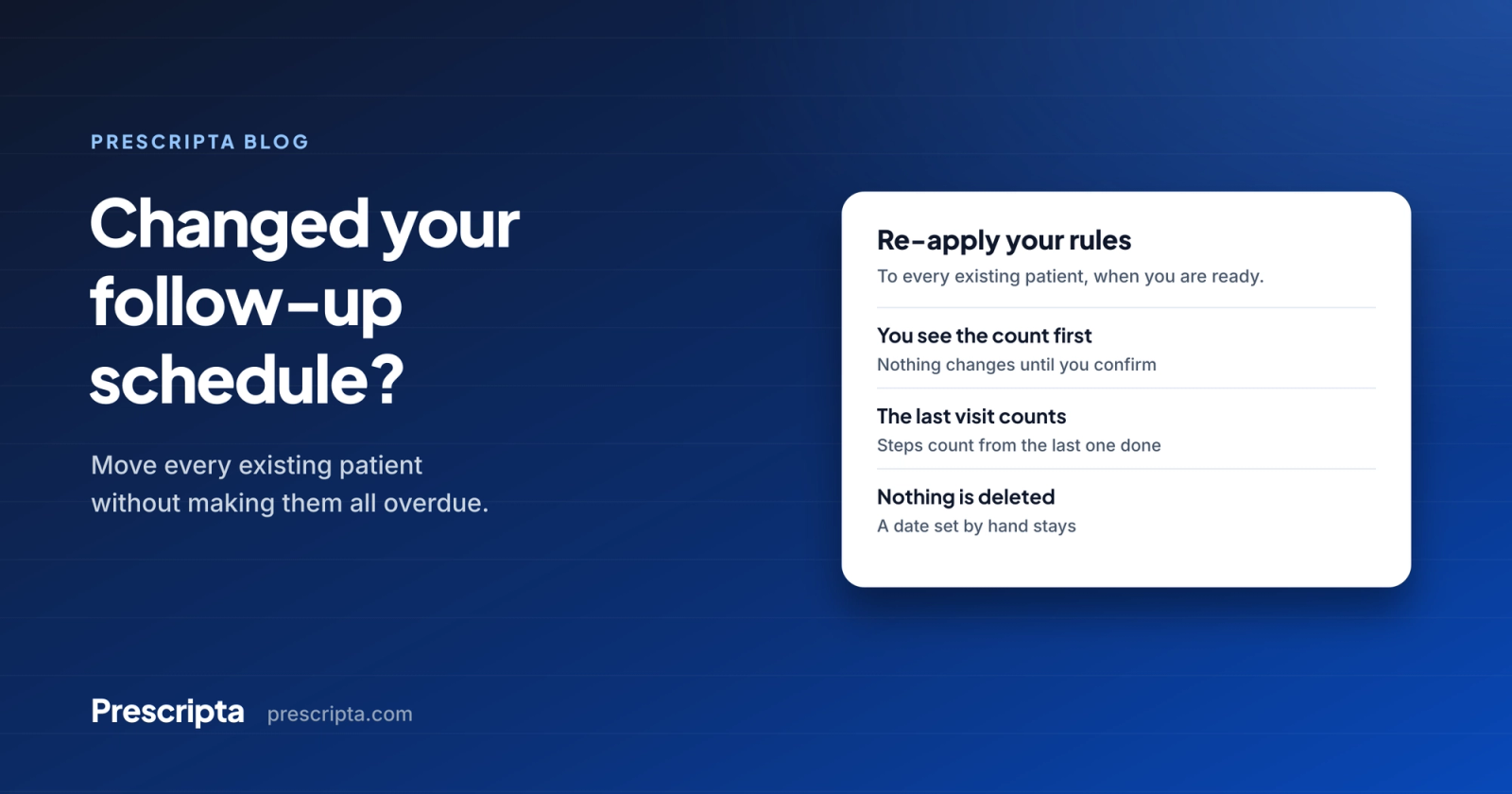
Patients keep the steps they started on until you choose to move them. When you are ready, one button applies your current membership types and scheduled steps to every existing patient.
- You see the count first. A box tells you how many patients will change. Nothing changes until you confirm.
- The last visit counts. Each step counts from the last one done. A patient you saw last week does not turn overdue.
- Nothing is deleted. A date someone set by hand stays as it is.
- One patient at a time works too. You can re-apply the schedule on a single patient's page.
A Patient With Two Memberships
A patient on a hormone membership and a second membership has a set of steps for each. The patient's page shows both, each under its membership name.
Start a free 7-day demo trial of Prescripta Clinic Manager and see it with a sample clinic. It is $99 a month per clinic with unlimited users.
Frequently asked questions
Do patients move to a new schedule by themselves?
No. They keep their steps until your clinic re-applies the rules.
Will new steps make a patient I just saw overdue?
No. Each step counts from the last one done.
Can I see what will change before it runs?
Yes. A box shows how many patients will change, and nothing changes until you confirm.
More from the Prescripta blog
Inactive patients clutter your work lists and hide the ones who need you. See how Clinic Manager moves them aside and brings them back on a new order.
A husband and wife on monthly medication should not pay shipping twice. See how Clinic Manager pairs orders to one address into one shipment.
Pharmacies ask for a reason for compounding and a diagnosis on compounded prescriptions. Enter it once per patient and Clinic Manager fills it in next time.
Send refill and follow-up reminder e-mails to GLP-1, TRT and hormone patients without putting health details in an inbox. Here is how Clinic Manager does it.
NexaMed is the healthcare marketing agency behind Prescripta. See how its marketing for HRT, TRT, peptide and GLP-1 clinics pairs with Clinic Manager.
Keragon lets you build your own HIPAA workflows. Clinic Manager comes already built for HRT, TRT, peptide and GLP-1 clinics at $99 a month. Compare both.
Charm EHR's Provider Plan is $200 per provider a month, and nurse practitioners count. Here is how the add-ons and overages add up, from Charm's own pricing page.
Many clinics hire a virtual assistant to chase membership renewals, refills and failed payments. Here is the HIPAA risk in sharing a login, and what software does instead.
Most med spa and aesthetic platforms have memberships and packages built in. They are built for services and credits. A GLP-1, hormone, or TRT membership is a medication on a schedule, and that needs a different kind of list.
Failed autopay, the paid month that does not match the medication month, downgrades that force refunds, liability nobody can see, and the handoff between billing and the pharmacy order. What each one costs and how to run it so it stops happening.
A working system for monthly medication memberships, from the spreadsheet that gets a new clinic through its first fifty members to the point where it breaks, and what replaces it.
Clinics shop for an OptiMantra alternative for three reasons: cost that climbs with add-ons and seats, a learning curve, and no way to track monthly medication memberships. Two of those have a replacement answer. The third has a cheaper one.
OptiMantra includes membership and package management in its base price. Here is what that covers, what its own guidance leaves to the clinic, what reviewers say about payments and reporting, and how clinics fill the gap without leaving OptiMantra.
Most clinics re-type every monthly GLP-1, hormone, and TRT refill into the pharmacy's portal. Prescripta Clinic Manager sends the order from the member's own row, pre-filled from the last one, and brings shipped and tracking back to the same screen.
Prescripta is an all-in-one EHR for specialty and wellness practices: booking, portal, charting with Quill AI, eRx, labs, eFax, payments, and a compounding pharmacy partner, on one bill.
A practical checklist for evaluating specialty EHRs: charting, prescriptions, labs, AI, scheduling, and the safeguards that make records hold up.
AI in an EMR should mean notes drafted during the visit, safer prescriptions, and a team that misses nothing. Here is what AI actually does inside a modern specialty EHR.
Zenoti runs the business side of spas and med spas well. When clinical care enters the picture, practices need a real EHR. Here is how to tell which side of that line you are on.
OptiMantra and Prescripta both target integrative and wellness clinics. Here is how they differ on charting, AI, prescribing safety, and day-to-day workflow.
How Prescripta and Cerbo compare for specialty and functional medicine practices, and the questions that actually decide which EHR fits your clinic.